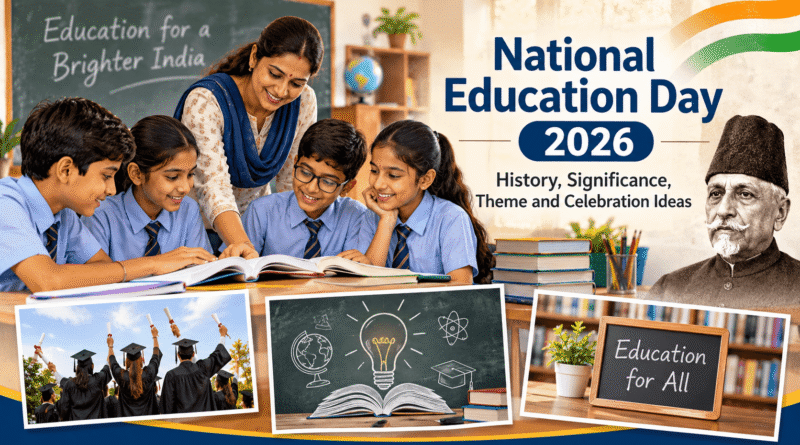
National Education Day 2026: History, Significance, Theme and Celebration Ideas
Every year on 11 November, India observes National Education Day in honour of Maulana Abul Kalam Azad, independent India’s first Education Minister. The day is more than a date on the school calendar: it invites us to think about access, equality, curiosity and the quality of learning.
In a country where learning conditions differ widely, the central question remains the same: does every student have a fair chance to learn, participate and build a future?
When Is National Education Day Celebrated in India?
National Education Day is observed on 11 November every year to mark the birth anniversary of Maulana Abul Kalam Azad, who was born on 11 November 1888. The Government of India began observing the day in 2008 in recognition of his contribution to education and nation-building. The Ministry of Education’s National Education Day 2024 note confirms the annual observance and identifies Azad as the first Education Minister of independent India.
History of National Education Day
The decision to commemorate 11 November was a way to recognise the role education would play in shaping a newly independent country. The then Ministry of Human Resource Development introduced the observance in 2008, as also recorded in the Ministry of Home Affairs’ list of national observances. Schools and colleges mark it through seminars, discussions, essay competitions and other learning activities; the government described 2015 as the eighth National Education Day.
Azad was born in Mecca and became known as a scholar, writer, journalist and leading figure in India’s freedom movement. After Independence, he served as Education Minister from 1947 until his death in 1958. His public life was shaped by a belief that education should not be reserved for a privileged few. He argued for universal primary education, girls’ education, modern science, technical and vocational learning, and opportunities for children regardless of their background. The Government of India’s biographical note on Maulana Azad records these priorities.
Maulana Abul Kalam Azad’s Contribution to Indian Education
Azad’s legacy can be seen in the institutions and ideas that helped shape modern Indian education. He supported a broad system that connected schools, universities, technical education and the arts. A few examples show the range of that work:
- Higher education and research: The first Indian Institute of Technology was established at Kharagpur in 1950 and formally inaugurated by Azad on 18 August 1951. The IIT Kharagpur history page documents this milestone. It is more accurate to describe his role in the early development of the IIT system than to suggest that he personally founded every IIT.
- University standards: Azad formally inaugurated the University Grants Commission on 28 December 1953. The UGC became a statutory body under an Act of Parliament in 1956. Its official history sets out this timeline.
- Culture and learning: He supported institutions that strengthened India’s cultural and academic life, including the Indian Council for Cultural Relations and national academies for music, literature and the visual arts.
- Education for all: He advocated free and compulsory primary education for children up to 14, women’s education, teaching modern sciences and access to education across communities and regions.
Azad’s vision matters because a good education system does more than prepare students for examinations. It helps them ask questions, understand different viewpoints, gain practical skills and take part in public life. That remains a useful standard by which to judge educational progress today.
National Education Day 2026 Theme
As of 7 November 2026, I could not verify an officially announced nationwide theme for National Education Day 2026 in the Ministry of Education or Press Information Bureau material reviewed for this article. Schools and colleges should therefore avoid describing an independently selected slogan as the Government of India’s official theme.
For a school or college programme, one suitable local theme could be “Learning for Every Learner: Inclusion, Curiosity and Opportunity.” It connects with Azad’s emphasis on education for all and gives students room to discuss inclusive classrooms, digital access, foundational learning, skills and lifelong education. Institutions can replace this suggested theme if an official 2026 theme is announced later.
Why National Education Day Still Matters
India has expanded access to education, but the figures also show why the work is unfinished. According to the Government of India’s September 2026 literacy factsheet, the Periodic Labour Force Survey (PLFS) 2025 estimated the literacy rate at 81.1% for people aged seven and above. The same factsheet reports more than 24.72 crore school enrolments in UDISE+ 2025-26. These figures show the scale of the education system, while differences between rural and urban areas and between men and women underline the need for continued attention to equity.
Higher education has expanded too. The government’s summary of AISHE data reports that enrolment increased from 3.42 crore in 2014-15 to 4.50 crore in 2023-24, while the gross enrolment ratio rose from 23.7% to 30% over the same period. The AISHE portal provides access to the official survey reports. These figures are not a reason to become complacent: students also need relevant teaching, supportive teachers, safe campuses, affordable pathways and opportunities to use what they learn.
The Right to Education Act, 2009, gives children aged six to fourteen a legal right to free and compulsory elementary education. The Act is available through India Code. The National Education Policy 2020 sets out a wider vision that includes foundational literacy and numeracy, a 5+3+3+4 school structure, experiential learning, vocational exposure and more flexible subject choices.
Think of a Class 8 student who is good at repairing a bicycle but has never been encouraged to explain the science behind it. A classroom that connects practical experience with physics, design and problem-solving can help that student see learning differently. This is an illustrative example, not a reported case, but it captures why education should recognise different strengths rather than measure every learner in only one way.
How to Celebrate National Education Day 2026
A meaningful celebration does not need an expensive stage or a long list of formal speeches. The best activities give students a chance to participate and connect the history of the day with their own learning experiences.
Ideas for Schools and Colleges
- Hold a short special assembly: Introduce Maulana Azad, explain why 11 November is observed and invite students to share one way education has changed their lives.
- Organise a quiz, speech or poster competition: Possible topics include “Education for All”, “The Role of Teachers in Nation-Building” and “What Makes a Classroom Inclusive?”.
- Run a reading or peer-learning activity: Senior students can read with younger learners, explain a difficult topic or help classmates practise language and numeracy skills.
- Host a career and skills conversation: Invite teachers, alumni or local professionals to discuss different routes into higher education, vocational training and employment. Link the discussion to informed choices rather than pushing one career path.
- Create a book-sharing corner: Ask students to bring a gently used book, add a short recommendation and make the collection available to classmates or a nearby community centre.
- Review accessibility: Ask whether school notices, activities and learning materials are usable by students with different physical, sensory, language and learning needs. Let students suggest practical improvements.
Ideas for Families and Communities
Parents can mark the day without turning it into another lecture about marks. Ask children what they enjoyed learning this year, which subject still feels difficult and what they would like to explore next. Families can visit a public library, share books, support a child with homework or help an adult learner practise reading and digital skills. Community groups can organise a book collection, a local tutoring hour or a session explaining available education support.
Students who are planning their next step can use the occasion to review study habits and learning goals. They may find practical ideas in our guide to study strategies for academic excellence. Those exploring online study can also read how distance learning can be adapted to different educational levels.
Frequently Asked Questions About National Education Day
Why is National Education Day celebrated on 11 November?
It marks the birth anniversary of Maulana Abul Kalam Azad, who was born on 11 November 1888 and served as independent India’s first Education Minister.
Who was Maulana Abul Kalam Azad?
He was a freedom fighter, scholar, writer and the first Education Minister of independent India. He served from 1947 until 1958 and advocated inclusive education, girls’ education, science and technical learning.
What is the official theme of National Education Day 2026?
No official nationwide theme could be verified from the Ministry of Education or PIB sources reviewed as of 7 November 2026. Schools may choose their own programme theme and should label it accordingly.
Where is National Education Day observed?
Schools, colleges, universities and education organisations across India mark the day through assemblies, discussions, competitions and community learning activities. The format may differ from one institution to another.
Conclusion: Keep the Focus on Learning for Everyone
National Education Day reminds us that education is about more than examinations, certificates or the number of schools and colleges. It is about whether every child feels welcome, every student can find a suitable path and adults who missed formal schooling have another chance to learn.
On 11 November 2026, remembering Maulana Abul Kalam Azad should lead to more than a speech or a social media post. It can begin with a book shared, a student encouraged, a learning barrier noticed or a useful question asked in class. Those small actions keep the purpose of the day alive: making education more meaningful, more inclusive and more accessible for everyone.
