
How to Study During Festivals in 2026: 10 Practical Ways to Balance Exams and Celebrations
You sit down with your maths notebook, ready to finish a set of questions before breakfast. Then someone asks you to help bring the decorations out. A relative calls to say they are on the way. Your phone starts buzzing with festival plans, and suddenly the hour you had set aside for studying is gone.
That is how festive days often go. A timetable that works on an ordinary Tuesday may fall apart when the house is busy, family is visiting, or you are travelling home for a celebration. It can be harder still when board exams, college submissions, JEE, NEET, or another important test is close.
You do not have to spend the festival shut away with your books. Nor is it helpful to ignore your syllabus for several days and hope you will somehow catch up later. A little planning, plus some flexibility when plans change, can help you enjoy the occasion and keep your studies moving.
Here are ten practical ways to study during festivals without making every spare minute feel like another exam.
Why studying during festivals can be difficult
The problem usually starts with a change in routine. Shopping, cooking, decorating, prayers, family visits, travel, and late dinners can take up the hours you normally use for homework. Even when you do find time to open a book, music from another room or a stream of messages can break your concentration.
There is also the familiar feeling of being in the wrong place. When you study, you may hear everyone laughing in the next room and worry that you are missing out. When you join them, you may remember the chapter you still have to revise. That back-and-forth can make a short study session feel more stressful than it needs to be.
Exam pressure is a real concern for many Indian students. In a survey conducted by NCERT in January to March 2022, around 80% of students in Classes 9–12 reported anxiety related to examinations and results, according to Down To Earth’s report. The survey was about student mental health generally, not festival study habits, and it does not describe every student’s experience. Still, it is a useful reminder to take academic stress seriously.
The aim during a festival week is to make a sensible plan for the time you actually have, not the time you wish you had.
1. Make a short plan before the celebrations begin
Try not to leave the planning until the morning of the festival. Spend 15 or 20 minutes a few days beforehand checking what is coming up at school or college and what your family has planned.
Write down your exam dates, assignment deadlines, unfinished chapters, and the topics you keep getting wrong. Then mark the days when you will be busiest. You may have a free morning before Diwali, for example, but little time on the evening when relatives arrive. If you are travelling for Eid or a family wedding, the day of the journey may be better suited to light revision than a full-length mock test.
Choose one or two tasks for each day. “Finish two calculus exercises” is easier to act on than “study maths.” You can add more if you have time, but you will already know what matters most.
A small plan made in advance is more useful than a perfect timetable made under pressure.
2. Build a festive-season study timetable you can follow
Your regular schedule may not fit festival days. If you usually study for several hours after school, copying those same hours into a day full of guests and family preparations is likely to frustrate you.
Instead, protect one session for demanding work, then fit lighter revision around it. Early morning suits some students because the house is still quiet. Others concentrate better after lunch or when the visitors have left. Use the time that works in your home, not the time that looks best on someone else’s timetable.
Sample study timetable for a festive day
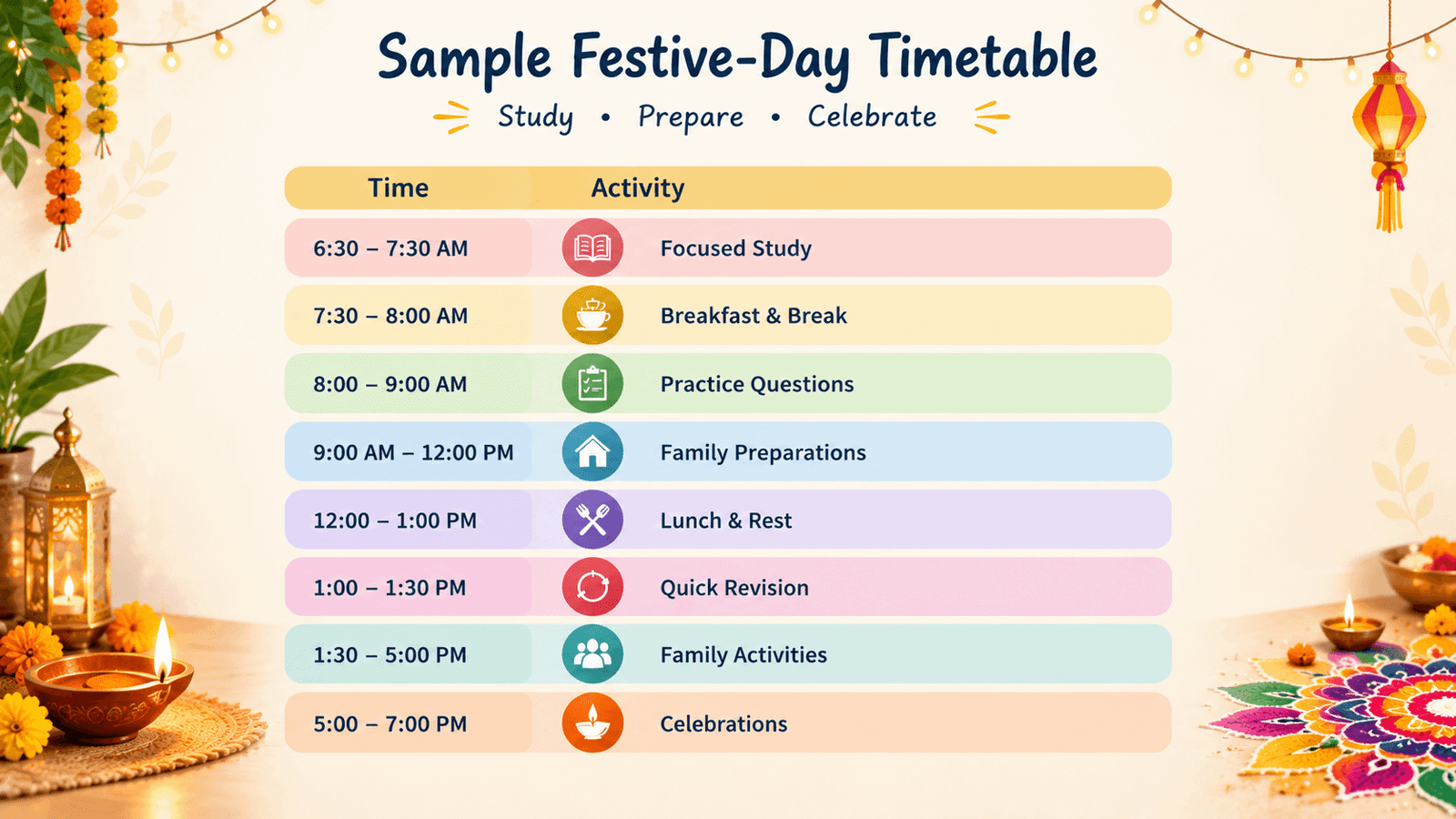
Treat this as a sample, not a rule. If the main celebration fills your whole day, a 30-minute review may be enough, especially if you have done the heavier work in advance. On a quieter day, you may be able to study for longer.
The point is to give your studies a place in the day without trying to schedule every minute.
3. Decide what can wait
When study time shrinks, it helps to stop treating every task as equally urgent. Make three quick lists:
- Do first: an exam topic you have not understood, an assignment due tomorrow, or a practice test you need to complete.
- Do if there is time: revision of a familiar chapter or extra questions on a topic you mostly understand.
- Leave for later: rewriting neat notes, reorganising folders, or optional exercises that are not needed for an upcoming test.
Imagine your Class 12 maths paper is a week away and you still make mistakes in integration. Spending your best hour solving problems and checking each error is likely to help more than decorating your formula notebook. If you are preparing for NEET, a short set of biology questions followed by a review of the wrong answers may be a better use of time than rereading an entire chapter without testing yourself.
Before each session, ask: “What will I be able to do by the time I finish?” The answer should describe an actual task, such as solving ten questions or explaining a concept from memory.
4. Use short sessions when the day is busy
A study session does not have to last two hours to be useful. If guests are arriving soon, choose one task that you can finish in 20 to 30 minutes. Put your phone away, work on that task, and check your answers before you stop.
You could revise five physics formulas and use each in a question, test yourself on a set of history dates, or write a brief summary of a biology process without looking at the textbook. These are manageable jobs with a clear finish line.
Some students like the Pomodoro Technique: 25 minutes of work followed by a five-minute break. Others prefer 40 or 50 minutes at a time. Use whichever rhythm helps you stay with the work. The timer is only a tool; it is not the goal.
If you have just half an hour before leaving for a family visit, do not spend the first ten minutes worrying that half an hour is too little. Pick a task and get started.
5. Test yourself instead of only rereading notes
When time is limited, it matters how you use it. Rereading a chapter can feel reassuring because the material looks familiar, but familiarity does not always mean you can recall it during an exam.
Try active recall. Read a section, close the book, and write down what you remember. Solve a question without checking the worked example. Explain the concept aloud as though a classmate has asked you for help. Then reopen your notes and correct what you missed.
Spacing revision across several days can help too. For instance, review chemical reactions before the festival, test yourself on them two days later, and return to the questions you got wrong at the end of the week. You do not need a complicated app to do this; a page in your notebook with three review dates will work.
A major review by Dunlosky and colleagues rated practice testing and distributed practice among the more useful learning techniques they examined. A later review in Nature Reviews Psychology discusses the evidence for retrieval practice and spacing across different learning settings. These methods are worth trying because they ask you to retrieve information, not simply look at it again.
6. Put a few limits on your phone
You might open your phone to reply to one message and end up watching festival reels for twenty minutes. That happens easily when friends are sharing outfit photos, shopping plans, or pictures of the decorations at home.
Before you start studying, turn on Do Not Disturb or silent mode and move the phone out of reach if you do not need it for the task. Decide when you will check messages, perhaps during breakfast or after your morning session. If you need your phone for a recorded lesson, download the material first and keep other apps closed.
Noise can be harder to control, especially in a full house. Ask whether you can have one quiet hour in a room away from the main gathering, or move your study session earlier. Headphones or earplugs may help when appropriate, but do not use them in situations where you need to hear what is happening around you.
You cannot control every interruption. You can make it easier to return to your work after one.
7. Tell your family when you need study time
Family members may know that exams are coming without realising how much work you still have to do. A calm, specific request is often more useful than saying you need to study all day.
For example: “My chemistry test is on Monday. I’m going to study from 7 to 8 in the morning. After that, I can help with the shopping and decorations.” You are letting everyone know when you will be unavailable and when you can join in.
It also helps to offer a practical compromise. Finish your study session before guests arrive, help with one of the preparations after lunch, or join the main celebration even if you skip a less important visit. If you are staying with relatives, let them know about an important deadline before the day becomes busy.
Plans will not always go exactly as you agreed. If your study hour gets interrupted, try to find another slot instead of turning the whole day into a write-off.
The American Psychological Association’s advice on holiday stress also encourages realistic expectations and flexibility.
8. Do not borrow time from sleep every night
After a late evening of celebrations, it can be tempting to wake up unusually early to make up for lost study time. Do it repeatedly and you may spend the next day tired, distracted, and slow to get through even simple questions.
The US Centers for Disease Control and Prevention says children aged 6–12 generally need 9–12 hours of sleep, while teenagers aged 13–17 need 8–10 hours. Sleep supports attention and memory as well as general health.
Try to keep your bedtime reasonably steady, eat proper meals, drink water, and take a short walk or stretch when you have been sitting for a long time. You can enjoy festive food without relying on sweets and snacks all day. If you have a late night planned, make the following morning’s study goal lighter instead of setting yourself up for a miserable start.
It is also fine to take a proper break on the main festival day if your deadlines allow it. You do not need to feel guilty about every hour you spend with family.
9. Make a lighter plan for travel days and visiting guests
Travel rarely gives you the same conditions as your desk at home. You may be in a crowded train, helping with luggage, or moving between relatives’ homes. A long mock test is probably not the right task for that day.
Pack something small and easy to use: a flashcard set, a formula sheet, vocabulary notes, or questions you have already attempted. If a safe and comfortable opportunity comes up, use a few minutes to review them. Leave difficult work for a time when you can sit down properly, and never compromise safety or rest to study during a journey.
If guests are coming to your home, do the demanding work before they arrive where possible. Once the house is busy, choose tasks that are easy to pause and resume. You might check five incorrect answers from yesterday’s test instead of starting a new chapter that needs an hour of uninterrupted attention.
Here is an illustrative example. Meera is in Class 10, and her family is hosting relatives for Diwali. She knows the afternoon will be busy, so she revises algebra in the morning and helps arrange snacks after lunch. By evening she has not completed every item on her original list, but she has finished the work she most needed to do. She moves two optional tasks to the following day and joins the family for the celebration. Meera is a fictional example, but the choice she makes is a useful one: decide what matters most, then adjust the rest without treating a change of plan as a failure.
10. Make it easy to get back to your usual routine
Sometimes the hardest part comes after the festival. Your sleep times may have shifted, your notes may be scattered in different bags, and a few assignments may still be waiting. It is easy to put off starting because the unfinished list feels too large.
On the last evening, take ten minutes to check what you completed and what still needs attention. Look at the next deadline, choose the first task for tomorrow, and put the book or notebook you need somewhere visible. That simple preparation saves you from spending the next morning deciding where to begin.
If you missed a couple of sessions, do not try to repay every lost hour in a single day. Split the pending work into smaller tasks and start with the most urgent one. You may need to return to your full timetable gradually, especially if you have been travelling or sleeping at different times.
If stress is becoming difficult to manage or is affecting your daily life, speak to a parent, teacher, school counsellor, or qualified mental health professional. Students in India can also find information and support resources through the Ministry of Education’s Manodarpan initiative.
A final word
A festival week will rarely go exactly to plan. Someone may arrive early, a shopping trip may take longer than expected, or a family event may run late. When that happens, choose the next useful task and carry on from there.
Do the work that genuinely needs your attention, leave room for the parts of the festival you care about, and return to your regular routine when the celebrations are over. You should be able to look back on the week and remember more than the chapters you were worried about finishing.
Happy learning, and enjoy the celebrations.
